 The Hopla! team
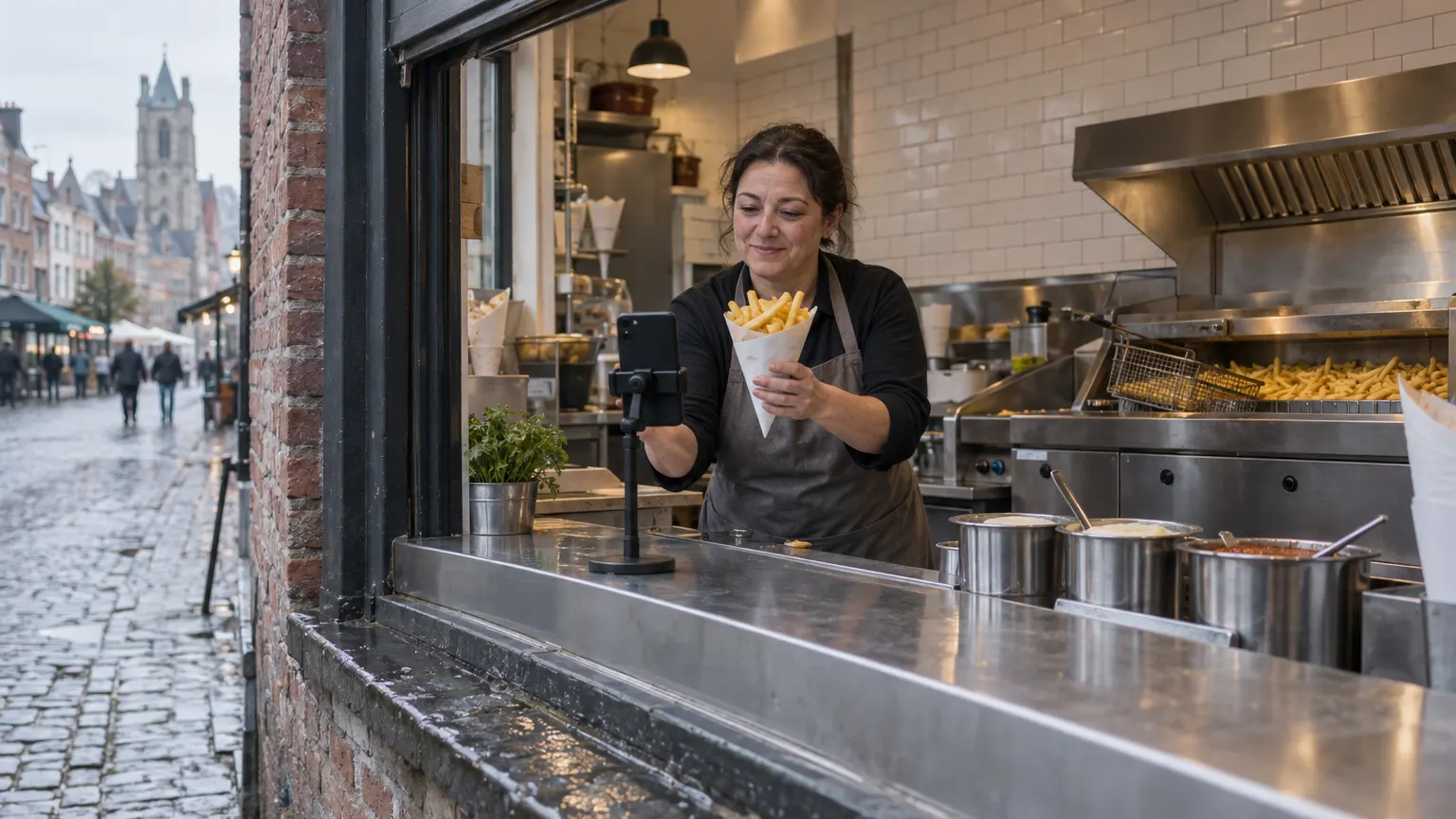
The videos that work in a given trade look alike. In chip shops, it's often the basket plunging into the fryer; at hairdressers, the before and after; in bakeries, the oven door. That's not a lack of imagination: a format that held viewers for someone else can hold yours. You just need to know how to take it apart, and put it back together with your own pieces.
Remaking isn't copying
Copying means taking the video: its footage, its text word for word, its staging down to the last detail. Remaking means taking the recipe: the order of the shots, the type of hook, the rhythm, then filming with what you, and only you, have. Someone watching both back to back should recognise the idea, not the video.
It works better, too. A copy puts you in second place: anyone who saw the original remembers it. Your version, with your counter, your homemade sauce and your accent, looks like nothing else.
Finding the right video to remake
- Search for your trade, not your town. In TikTok, type “friterie”, “artisan bakery”, “barber”. See what's working in Lille, Liège or Ghent: an idea from somewhere else doesn't put you head to head with the competitor on your street.
- Pick shops over influencers. A chip shop filming its own counter teaches you more than a passing creator: its means are your means.
- Compare with the rest of the account. On the profile, TikTok shows the views for each video. The one that does far better than the others on the same account has something: it isn't the shop's fame, it's the format.
- Stick to recent videos. Sounds and turns of phrase change fast: go for a video from the last few weeks.
Sorting through them takes time, but half an hour of searching, once a month, is enough to start with. If the video that inspires you comes from a shop in your neighbourhood, first read how to look at your competitors without imitating them.
Breaking the video down in five points
Watch it three times: the first as a viewer, the next two with a notebook. Write down:
- The hook. What do you see, hear and read in the first few seconds? In its advice to advertisers, TikTok recommends getting the key point across in the first 3 seconds: that's where the video won its audience.
- The format. Behind the scenes, a gesture, before and after, the customer's point of view, a question, a ranking? Count the shots and how long each one lasts.
- The sound. A trending track, a voice, or the sound of the gesture itself (the fryer, the scissors, the crust)? Note the sound's name, shown at the bottom of the video.
- The on-screen text. How many words, where, at what moment? Copy it out to analyse it, not to reuse it.
- The ending. How does it finish? A result shown, a question to viewers, a last image that links back to the first so the video loops?
Template: the breakdown sheet for the video to remake
- Hook: what you see and read before the third second.
- Format and shots: the type of video, the number of shots, how long they last.
- Sound: its name, or “sound of the gesture”, or “voice”.
- On-screen text: how many words, and where.
- Ending: the last image.
- What I keep, what I change.
One line per point. If you can't sum up the hook in one sentence, choose another video: this one probably relies on a personality or a fluke you won't be able to repeat.
Shooting your version
Keep the structure, change everything else.
- What you keep: the type of hook, the order of the shots, the rhythm, the length, the kind of ending.
- What you change: the product (yours, the one people come to you for), the place (your counter, your street, your town), the person (you, your team) and the words of the on-screen text.
- What you add: a detail only you can show. The homemade sauce, the beef dripping in the fryer, the Friday regular who agreed to be filmed.
Then watch the two videos one after the other. If someone could think they were the same, you're too close: change the angle, the product or the ending.
What's allowed, what isn't
You can
- Reuse a format or a structure. Behind the scenes, before and after, the question to the customer: these belong to nobody.
- Reuse a general idea: showing the double frying, filming the Friday-night queue.
- Use a sound available in TikTok, chosen from within the app. With a business account, you draw on the Commercial Music Library: according to the TikTok Ads Manager help centre, it holds a million tracks cleared in advance for businesses. If the original video's sound isn't in it, pick one with a similar rhythm.
You can't
- Reuse someone else's video: download it and repost it, even cropped, even with your own text on top. The footage belongs to whoever filmed it.
- Copy their text word for word, their name or their logo, or let people think their footage was shot at your place.
- Paste in a song recorded from another app.
- Film someone without their consent. Article XI.174 of the Code of Economic Law prohibits sharing a person's image without their agreement. Consent can be verbal, but the Data Protection Authority recommends getting it in writing so you can prove it.
- Name a competitor to compare yourself with them: comparative advertising is strictly regulated by Article VI.17 of the same code. The simplest thing is never to name anyone.
The example of a chip shop in Charleroi
Example
An imagined case, to show the method. Nadia runs a friterie, a Belgian chip shop, in Charleroi's Ville-Basse (the lower town). One Monday evening, she searches “friterie” on TikTok and comes across a chip stand in Lille. Its videos usually get around 2,000 views; one of them shows 85,000.
Her sheet:
- Hook: the basket plunging into the fat, in extreme close-up, sizzling away. Text: “Why our chips stay crispy”.
- Format: the gesture explained, five shots of two seconds.
- Sound: the noise of the fryer, then one line from the owner.
- On-screen text: one sentence, at the top, from the very first frame.
- Ending: the cone shaken and held out to the camera, then the video starts again on the basket.
Her version: she keeps the basket hook, the five shots and the cone held out at the end. She changes everything else. Her product: her chips, fried twice in beef dripping, which she shows in the tub before frying. Her place: her counter, with the window onto the wet street. Who's in it: herself, doing the voice, with her Charleroi accent. Her text: “Fried twice, the way we've done it since 1998”. Her ending: the cone held out, then her homemade sauce poured over the top, which the Lille video didn't have. Her sound: the sizzle of her own fryer, nothing else.
She films on Tuesday at 11am, before opening, in ten minutes, and posts in the evening with the caption “Fried twice, beef dripping, homemade sauce. Open from 11.30am. #charleroi #friterie #chips”. A week later, she compares this video's views with her other videos, not with the 85,000 from Lille.
After posting
Compare your version with your own videos, never with the original: an account that's just starting out isn't playing in the same league. If it beats your average, you've found a format. Do it again two or three weeks later with another product. If it does worse, change one thing only, the hook first, and try again. For a shot-by-shot video template, read the free survival guide for local shops (in French).
To do this week
- Search for your trade on TikTok and note three videos that get clearly more views than the others on the same account.
- Fill in the sheet for the best of the three.
- Shoot your version: same structure, your product, your place, your face.